Shannon Testifies at House Hearing on Future of Nuclear Power: ‘We Need Your Support’

As Congress weighs how to accelerate the nation’s leadership in advanced nuclear reactors, NC State’s Steve Shannon has a seat at the table.
The House Committee on Science, Space and Technology Subcommittee on Energy selected Shannon, department head of NC State Nuclear Engineering (NE), as one of five industry and academic experts to testify on the state of nuclear power earlier this month.
At the hearing, titled “Powering the Nuclear Renaissance: Accelerating U.S. Leadership in Advanced Nuclear Reactors,” Shannon delivered four main points:
- Advanced nuclear technology is ready.
- The next generation is showing up, and we need to be ready for them.
- The workforce gap urgently needs to be filled.
- University research and the test reactor infrastructure is a national gap that must be filled.
Advanced Nuclear Technology is Ready
Shannon testified that nuclear power is having a momentous moment in the U.S., with decades of research resulting in safer reactor designs, new materials and advanced instrumentation and controls.
Shannon told the committee representatives that nuclear power is ready to contribute to the nation’s energy needs.
“The technology is not waiting on invention, it’s waiting on investment and deployment,” Shannon said.
The Next Generation is Showing Up
Shannon said universities are seeing a surge in nuclear engineering students.
This fall, more than 100 students enrolled in NC State’s introductory course on nuclear engineering, which is more than double the enrollment from three years ago. This trend, he said, is happening at peer institutions across the nation.
“That enthusiasm is real, and it is fragile,” Shannon said. “We cannot afford to let the momentum of this moment outrun our capacity to educate and train these students. Sustained investment in faculty, facilities and research funding is not optional, it’s the foundation.”
The Workforce Gap Urgently Needs to be Filled
At a recent workforce development workshop hosted at NC State, Shannon said industry professionals in attendance all shared a similar sentiment: the demand for nuclear professionals is far outpacing the rate of training.
He said the need goes beyond engineers; developing operators, maintenance technicians, fuel cycle specialists and cybersecurity professionals is increasingly necessary.
“The forecast deployment of advanced nuclear technology in the coming decades could be three times the installed base prior to 2020,” Shannon said. “The workforce pipeline for that scale of growth does not exist yet, and building it will require parallel pathways.”
Those parallel pathways could include classroom training that runs alongside industry experience, apprenticeships linked to engineering test facilities and online programs for working professionals to retrain and upgrade their knowledge.
University Research and the Test Reactor Infrastructure is a National Gap That Must be Filled
Lastly, Shannon urged federal support for universities that are leading research in the next generation of nuclear facilities.
He said university support is essential in accelerating the commercial deployment of nuclear power. He noted that NC State’s proposed advanced research and test reactor (ARTR), along with facilities at peer institutions, addresses testing gaps in advanced nuclear designs.
“These are not competing with industry, they are complementary efforts,” Shannon said.
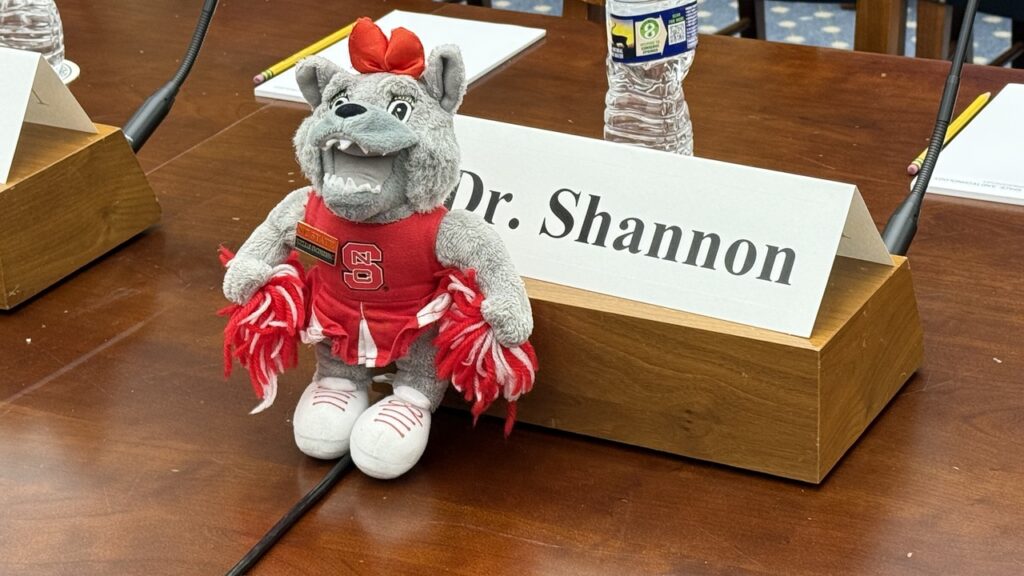
Shannon, who proudly displayed a Ms. Wuf stuffed animal on the table in front of him throughout his testimony, concluded with, “We are ready to go, but we need your support.”
This post was originally published in the Department of Nuclear Engineering..
This post was originally published in College of Engineering News.